Heads up: EverydayChecked is reader-supported. If you buy through links on this page, we may earn a small commission, at no extra cost to you. It never changes our verdict.
Why it matters
A dirty Keurig quietly ruins your coffee
A Keurig hides its mess well. The cup looks fine, the machine looks fine, and yet the coffee starts tasting flat, bitter, or just off. That’s almost never the pod or the beans. It’s the machine.
Every brew leaves a little behind. Over weeks and months, three things accumulate in the parts you never see:
- Old grinds and residue collect in the pod holder, funnel, and exit needle, where they go stale and seep into every cup that follows.
- Mineral deposits from tap water (scale) coat the internal lines, slow the flow, and drag down the brew temperature.
- The two combine into a stale, slightly metallic taste that no amount of wiping the outside will fix.
Left alone, that buildup doesn’t just taint the coffee; it shortens the machine’s life. The fix is to clean what’s actually inside, and that’s exactly what a cleaning pod does.
![Quick & Clean [6-Pack] Keurig Cleaning Pods](/images/keurig-machine-clean/cleaning-pods.jpg)
The one we use
Quick & Clean [6-Pack] Keurig Cleaning Pods
- 6 pods / pack
- ~3 months of cleaning
- Non-toxic
- Keurig 1.0 & 2.0
- Runs through like a normal brew, no disassembly
- Cuts through old grinds, residue, and scale
- Biodegradable, no harsh chemicals
- One pack lasts roughly three months
We may earn a commission, at no extra cost to you.
The easy way
How a cleaning pod actually works
This is the part that won me over: it’s no harder than making a coffee. You don’t take anything apart, you don’t mix a solution, you don’t scrub. The pod goes in the holder like any K-Cup, and the cleaning formula does its work as the hot water runs through the same path your coffee takes, clearing the holder, funnel, and exit needle on the way.
- You already know the motion. If you can brew a cup, you can clean the machine. That’s the whole appeal: literally anyone can do it.
- It reaches what wiping can’t. The formula flows through the internal parts a paper towel will never touch.
- A rinse finishes the job. One plain-water cycle afterward flushes any cleaning residue out, so the next cup tastes like coffee, not soap.
Step by step
How to use Quick & Clean pods
The full routine takes about five minutes, most of which is just waiting for two brew cycles:
- Insert the pod. Drop a Quick & Clean pod into the holder exactly like a coffee K-Cup.
- Brew a large cycle. Use the biggest cup setting so the most water runs through.
- Discard the liquid and the pod. Pour it out and toss the used pod.
- Run a water-only cycle. Brew one more large cycle with nothing in the holder to rinse the machine.
- Discard the rinse water. That’s it. The machine is clean and ready to brew.
That’s the entire process. No tools, no mess, no taking the Keurig apart.
Real-world test
What happened with our office machine
Our office Keurig had been around for years, and nobody ever wanted to be the one to clean it. Eventually people started complaining about the taste, the tea drinkers first, since there’s nowhere for an off-flavor to hide in a cup of tea. Wiping it down with a paper towel did nothing, because the problem wasn’t on the outside.
The Quick & Clean pods were exactly what we needed. Pop one in, let it run, and the machine is genuinely clean. The complaints stopped, and because cleaning it is identical to using it, the job stopped falling on one person, since anyone could do it in passing.
No more complaints about the taste, and no more arguments about whose turn it is to clean it.
I started using them at home too, but the office is where they earned their keep. A shared machine that nobody maintains is the worst-case scenario, and this made the fix effortless enough that it actually got done.
Side by side
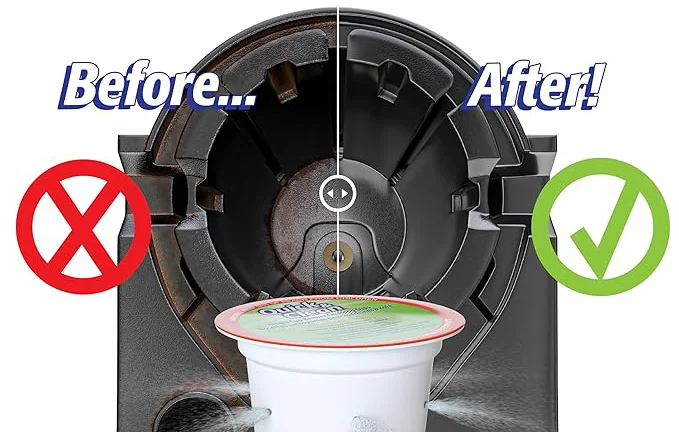
A neglected machine vs. a cleaned one
Neglected machine
- Coffee tastes stale or metallic
- Old grinds and scale build up inside
- Slower flow, cooler brew temperature
- Wiping the outside does nothing
Cleaned machine
- Coffee tastes fresh again
- Internal parts cleared of residue
- Water flows and heats properly
- Five-minute fix, no disassembly
Tips
Keep your Keurig fresh between cleanings
A cleaning pod handles the residue, but a few habits keep buildup from coming back as fast:
- Use filtered water. Minerals in tap water are what form scale inside the machine. Filtered water slows that down and keeps the coffee tasting cleaner.
- Replace the water filter on schedule. Follow your machine’s instructions. The filter strips out chlorine, sediment, and minerals before they reach the brew.
- Stick to Keurig-approved cartridges. They’re built for the machine; off-brand parts can void the warranty and, in some cases, cause damage.
- Wipe the exterior. A damp cloth keeps dust and bacteria off the outside. Purely cosmetic, but worth it.
- Descale every three to six months. A cleaning pod doesn’t replace descaling. Use a Keurig-approved descaling solution to strip out the deeper mineral scale the pods don’t reach.
That last point matters: cleaning pods and descaling solutions do different jobs. The pod clears grinds and residue; the descaler tackles hard-water scale. Used together, they keep the machine brewing hot and tasting right for years.
The bottom line
So, are cleaning pods worth it?
If your coffee has started tasting flat and wiping the machine hasn’t helped, this is the cheapest, simplest thing to try, and in our experience it works on the first run. A six-pack lasts about three months at the recommended once-a-month cadence, which makes the per-clean cost trivial.
The real win is that it’s effortless enough to actually keep up with. A maintenance routine only helps if you do it, and “brew a pod, brew some water” is about as low-friction as it gets. Pair it with the occasional descale and your Keurig keeps earning its spot on the counter.
Questions
FAQ: cleaning your Keurig
What exactly are Quick & Clean pods? They’re cleaning pods made specifically for Keurig machines. A proprietary formula runs through the machine like a normal brew to clear out old grinds, residue, and mineral deposits, restoring the coffee’s taste and helping the machine last longer.
How do I use them? Insert a pod, brew a large cycle, discard the liquid and the pod, then brew one more large cycle with water only to rinse. Discard the rinse water and you’re done.
How often should I clean my Keurig? About once a month for most machines, or after roughly every 200 brews. A heavily used shared machine may want it a little more often.
Are the pods safe to use? Yes. They’re non-toxic, biodegradable, and gentle on the machine. There are no harsh chemicals to handle or rinse out beyond the standard water cycle.
Do cleaning pods replace descaling? No. Pods clear grinds and residue; descaling solution removes hard-water mineral scale. They’re complementary, so use a Keurig-approved descaler every three to six months as well.
Will they work with my machine? They’re compatible with Keurig 1.0 and 2.0 machines, so they cover the vast majority of home and office brewers.
Where can I buy them? They’re sold on Amazon and through other online retailers, usually in a six-pack.